Pillow
Designing a support service with women after domestic abuse.
I was one of two team leaders in a UX for Change fellowship, designing Pillow with women who have experienced domestic abuse. I led three designers from co-imagining with survivors to two tested concepts, and I kept working with Pillow after the fellowship ended.
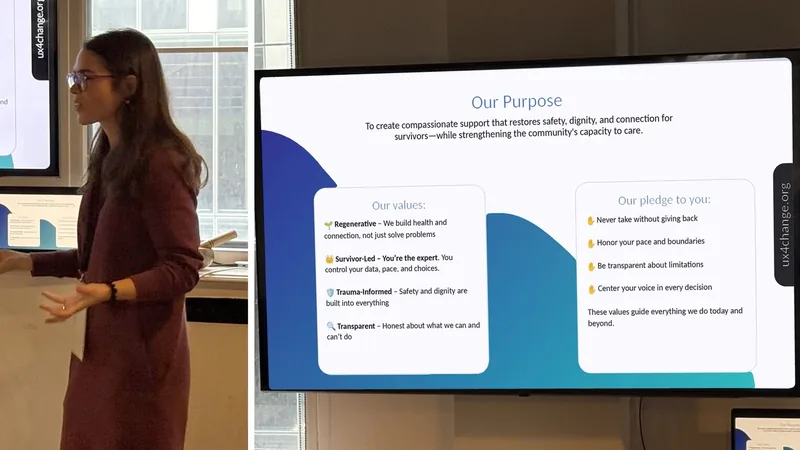
At a glance
The problem at a glance
There is no unified route through which women survive and thrive after domestic abuse.
Once they leave the crisis, they move from service to service and navigate a complex legal system.
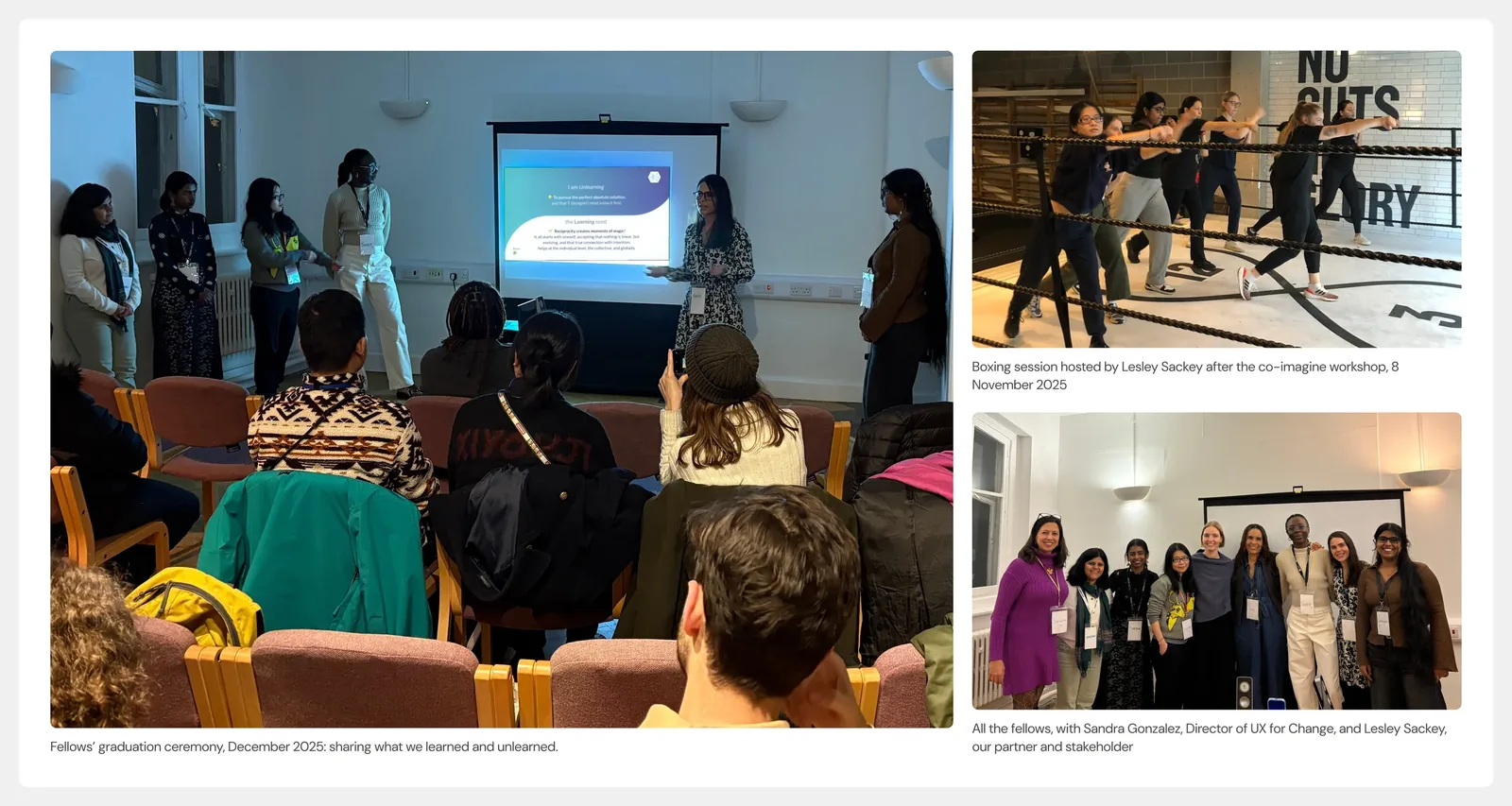
Lesley Sackey, a GB boxing champion and founder of Fight Forward, a boxing programme for survivors, envisioned Pillow with Sandra González, Director of UX for Change: a community-led support service for women after the crisis. In September 2025, eight fellows in UX for Change's second Responsible Design for Change Fellowship came together to co-create it, with Lesley as our stakeholder.
More detailsProject Milestones
What I did, Milestone 1 (fellowship): I put Responsible Design methodologies into practice by mapping the system, setting the team's process, co-leading a co-imagine workshop with survivors, scoping testing to one claim, and reviewing design progress.
The constraint that shaped the process: Lesley was reachable only through our coach, so requirements arrived in pieces, and we never had a brief we could scope against.
What I did, Milestone 2 (volunteering): organised harms mapping and a competitor review, then led prioritising changes to get the prototype ready for the pitch. Read the 'What happened next'.
What changed: testing reframed the brief from telling your story once to deciding what to share. The founder asked the team to continue, and I'm helping get the prototype ready for her November pitch.
My role and the team
Leading three designers through an open brief
Milestone 1: the fellowship, September to December 2025. I was one of two team leaders, each leading three individual contributors (ICs). My team was Julia, Shamika and Therese. Ana and I took the regenerative leadership track and received one-to-one coaching from Sandra González.
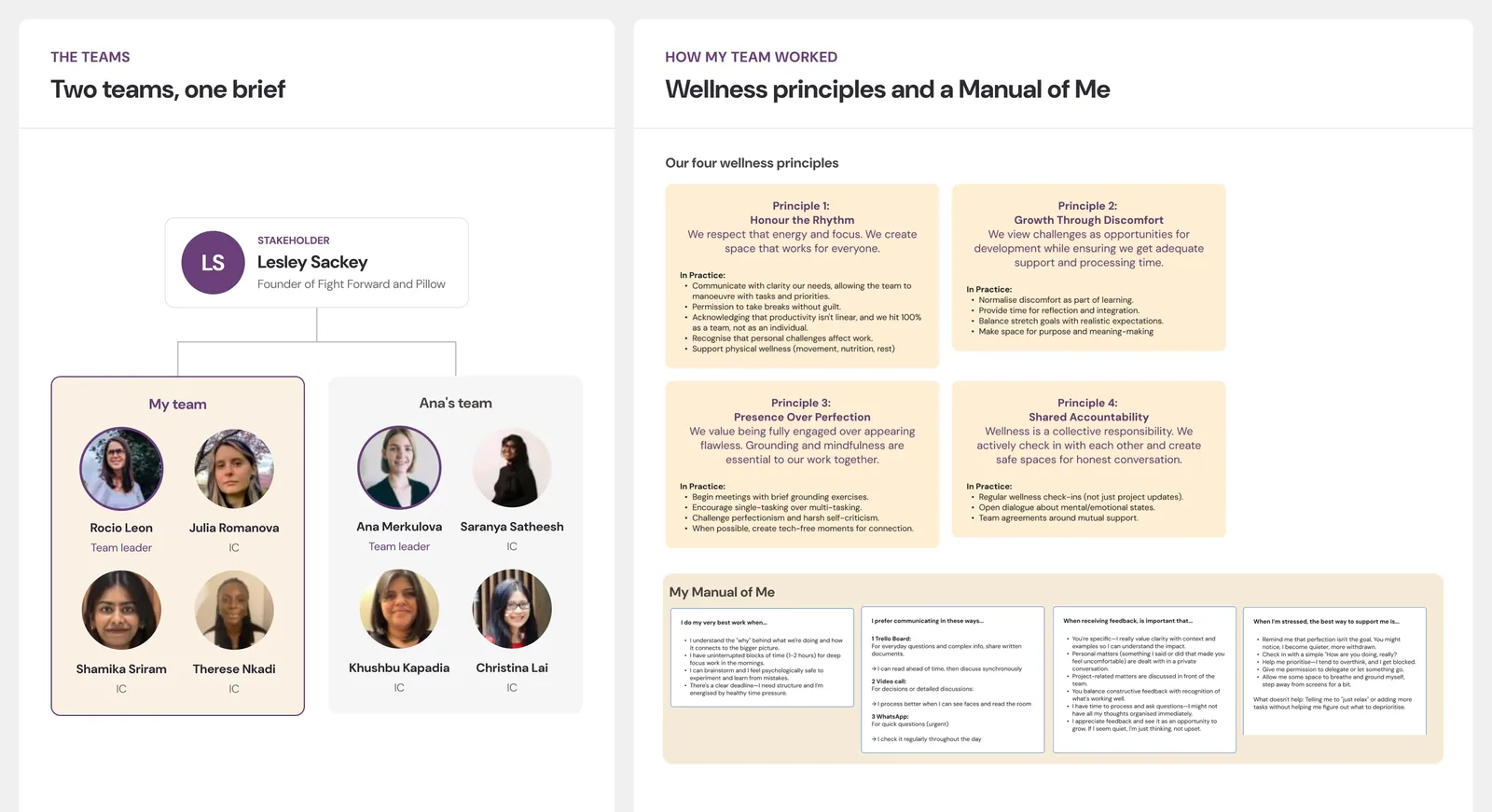
Setting the team up. In week 1, I introduced a Manual of Me and wrote four wellness principles for my team. I allocated work to volunteers first, ran Friday planning and opened every meeting with a five-minute grounding exercise, which I later handed around until the ICs led it themselves.
Giving the team direction: I asked everyone to draft a process so we could merge them, but they didn't reconcile. Situational Leadership showed me the team needed direction more than consensus, so I combined the drafts into one weekly plan built around everyone's jobs.
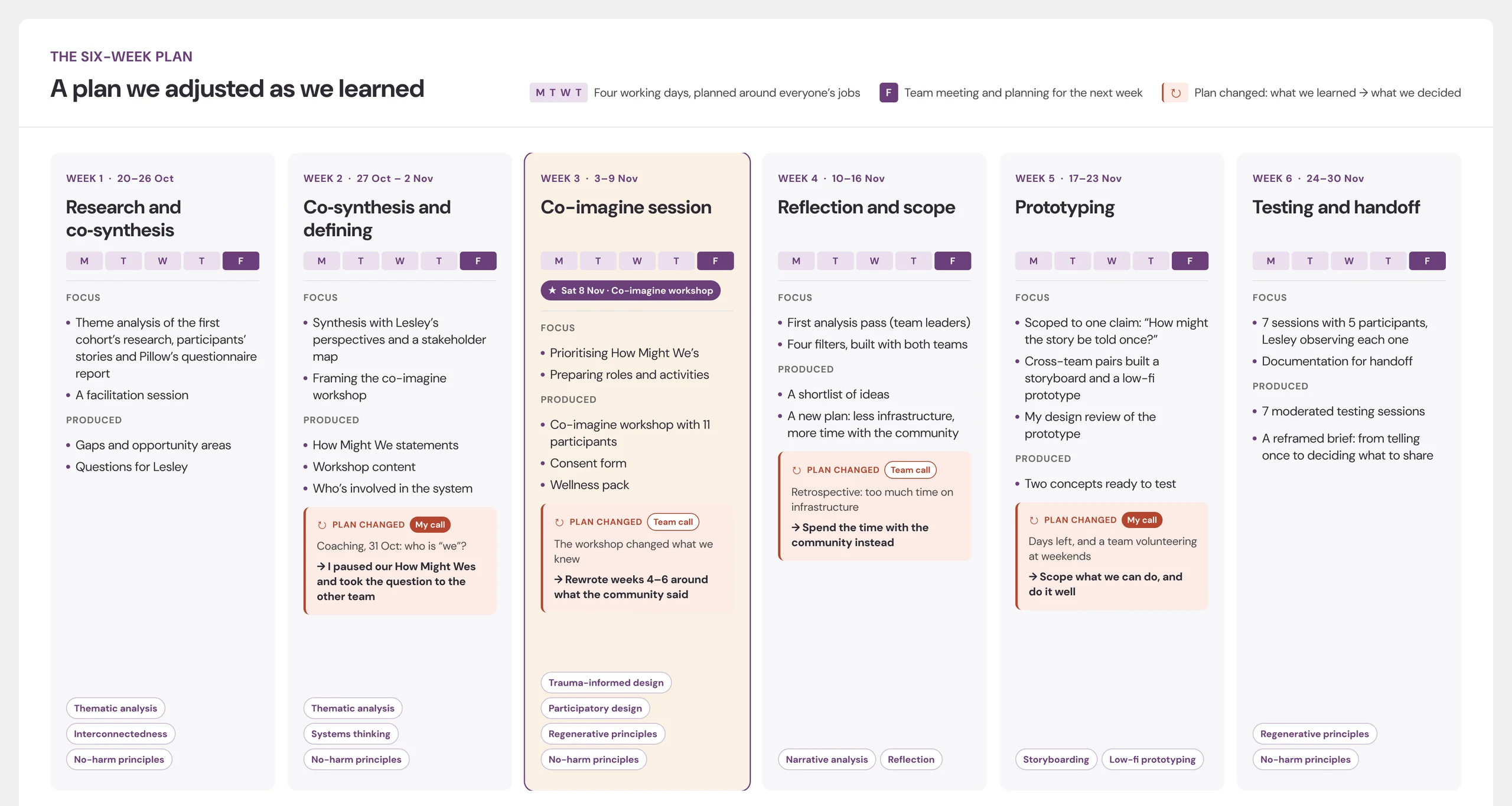
Before the workshop
Learning the method, then mapping the system
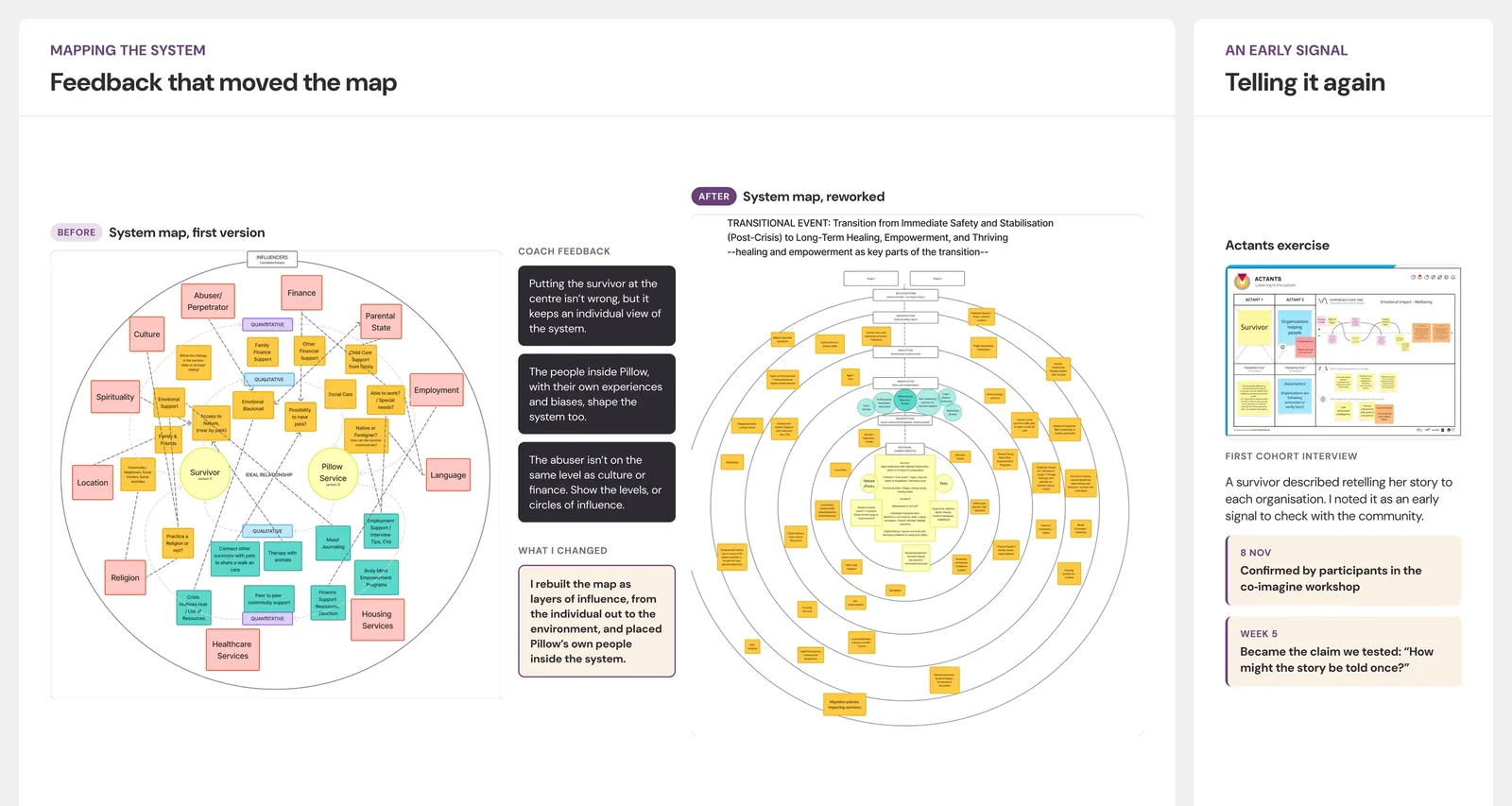
The exercise that shaped my thinking most was mapping the system. I built a system map in FigJam with the Systemic Design Toolkit. I put the survivor at the centre; Cecilia's feedback was that this kept the view individual, and that the people inside Pillow also shape the system. Listening to one of the first cohort's user interviews, I heard a survivor describe retelling her story to each organisation. I noted it as an early signal to check with the community.
Pivot momentWho frames the problem?
Preparing for the workshop, both teams reached for How Might We statements, each working separately. In a coaching session with my team, Cecilia asked one question: who is "we"? The familiar framework had quietly put the designers' voice ahead of the survivors', deciding on their behalf what mattered.
I paused our work and shared the feedback with the other team. Both teams then decided together what to do next, and that is where we converged. We learned that you can't remove yourself from the process, but you can make your position visible and correct it.
The co-imagine workshop
Co-imagining the future of support
We chose a speculative approach: participants imagined what an ideal future looks, feels and sounds like (Experience Map), and how they'd get there (Pathway Map).
Lesley hosted. Ana and I led the check-ins, presented the activities, and held the room, while the ICs facilitated in pairs across the tables. During the break, I co-led a 7-min movement meditation practice, bringing stillness in the middle of a demanding session.
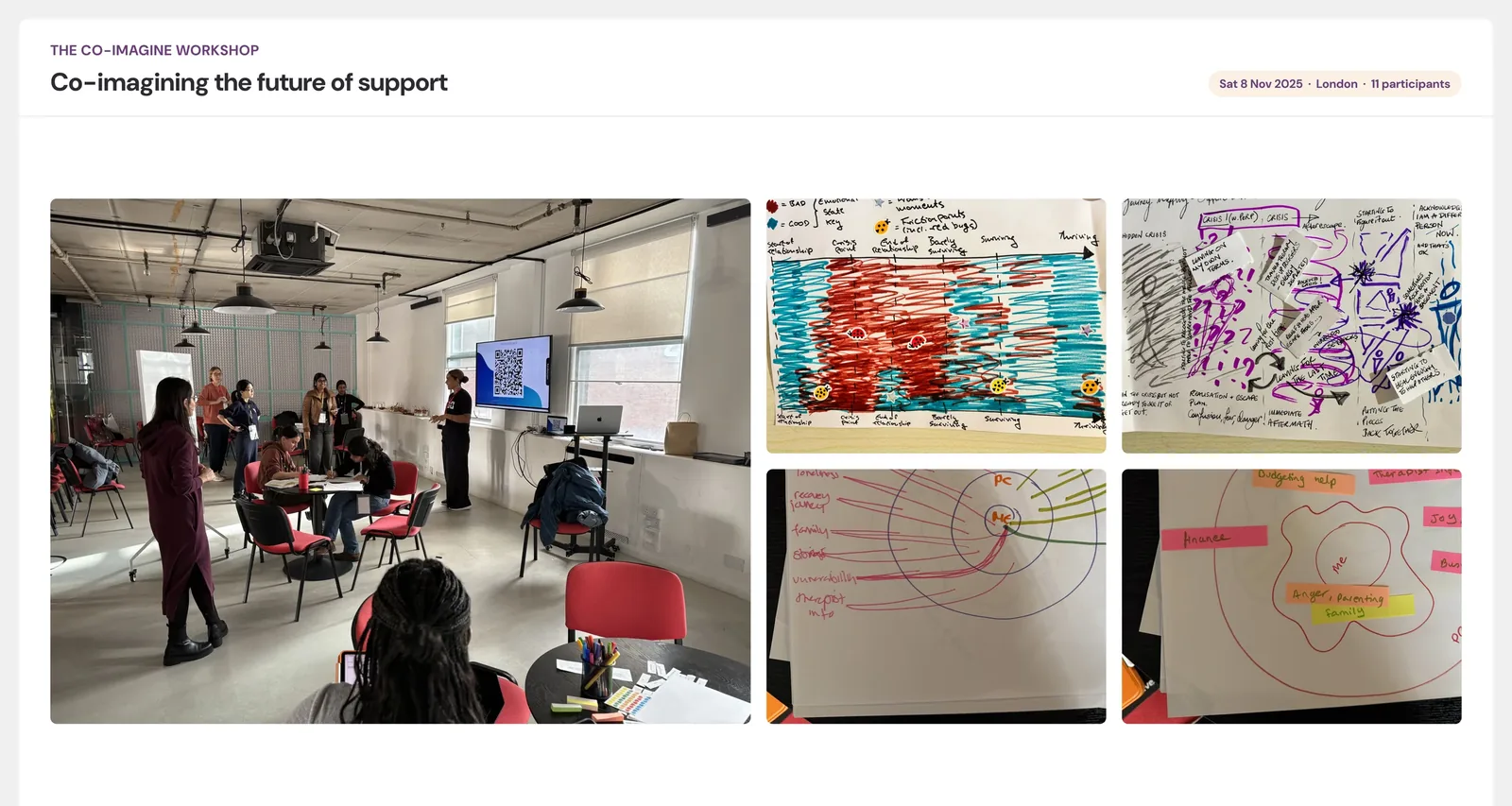
Three patterns came up repeatedly
- Autonomy or agency: Survivors want to choose what support they receive, and when.
- Sharing: the need to be heard pulls against the pain of explaining again and again.
- Support: resources and services are not helpful without emotional support, solidarity and lived-experience validation.
The second pattern confirmed the signal I'd heard in the first-cohort interview, this time from participants themselves.
If there was a space where you could get a lot of answers in one place, that would feel just a little bit lighter.
Workshop participant
We sent consent forms ahead so people could read and amend them, and participants received a Wellness Pack. Sharing was explicitly optional. Lesley co-facilitated as a trusted intermediary, making the room feel safe. Fellows worked in pairs because facilitators can be triggered too.
Two decisions after the workshop
From rich material to one testable claim
The co-imagine workshop gave us more than we expected, with two weeks left. Two decisions turned it into something we could test.
1. Building a way to decide. There was no obvious consensus on how to group what we had, so both teams worked out four filters: high evidence, type of insight, theme fit, and what we would actually build in the time left.
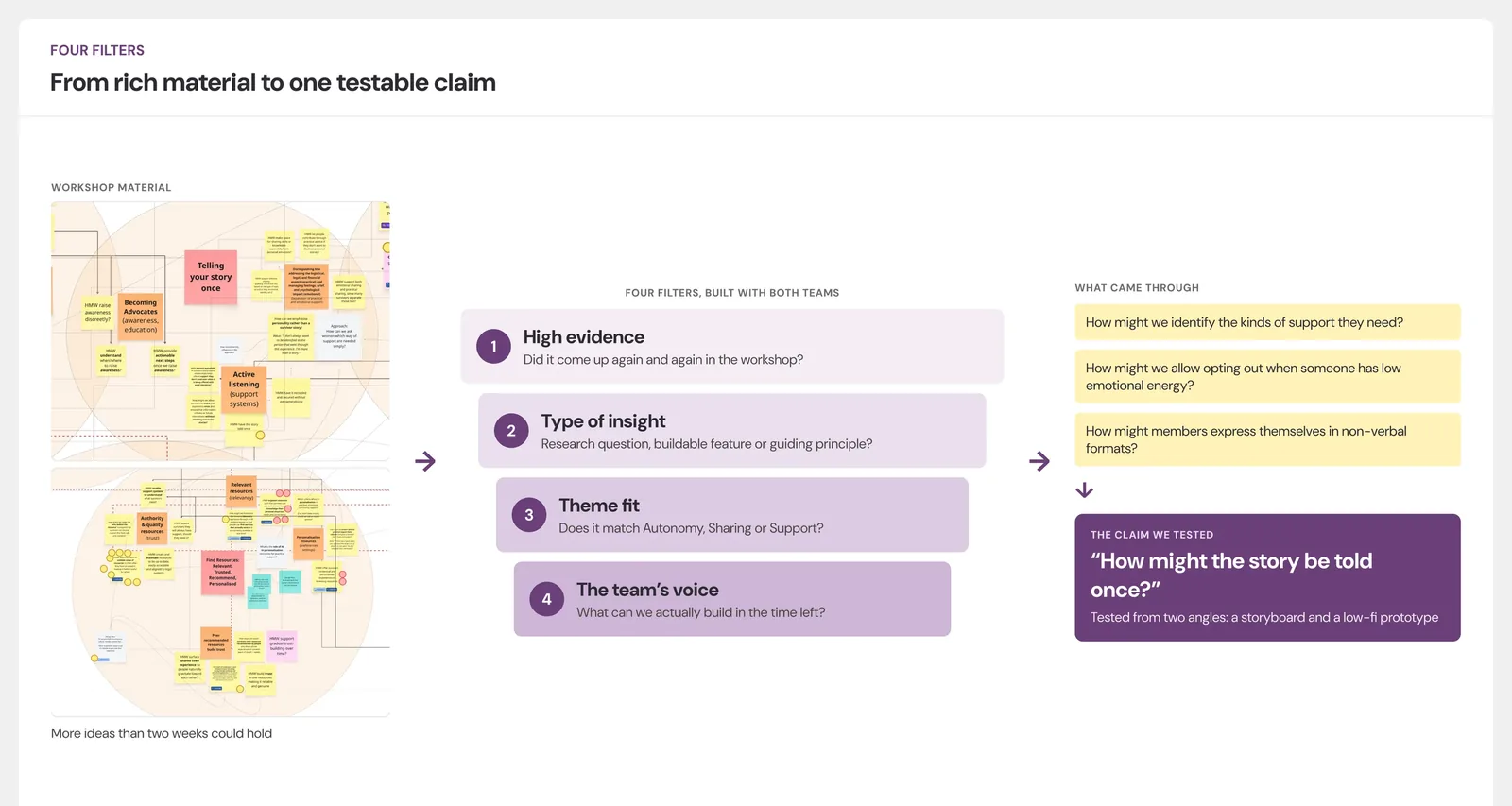
2. Scoping to one testable claim. With days left and the team volunteering at weekends, we chose to test one claim with intention: "How might the story be told once?" We tested it from two angles, a storyboard and a low-fi prototype, each built by a pair of ICs from both teams. Lesley recruited five workshop participants for moderated online sessions.
What we made and tested
Testing showed the value was in deciding
The concept 1 storyboard walked participants through documenting key information, then choosing what to share with which organisation. The concept 2 low-fi prototype, done by Julia (my team) and Khushbu (other team), tested a private journal: an emotional check-in, writing with optional prompts, and support matched to what's shared.
Five participants took part in seven sessions in the final week: four on the prototype and three on the storyboard. ICs facilitated the remote moderated sessions. Lesley observed every session alongside a team leader.
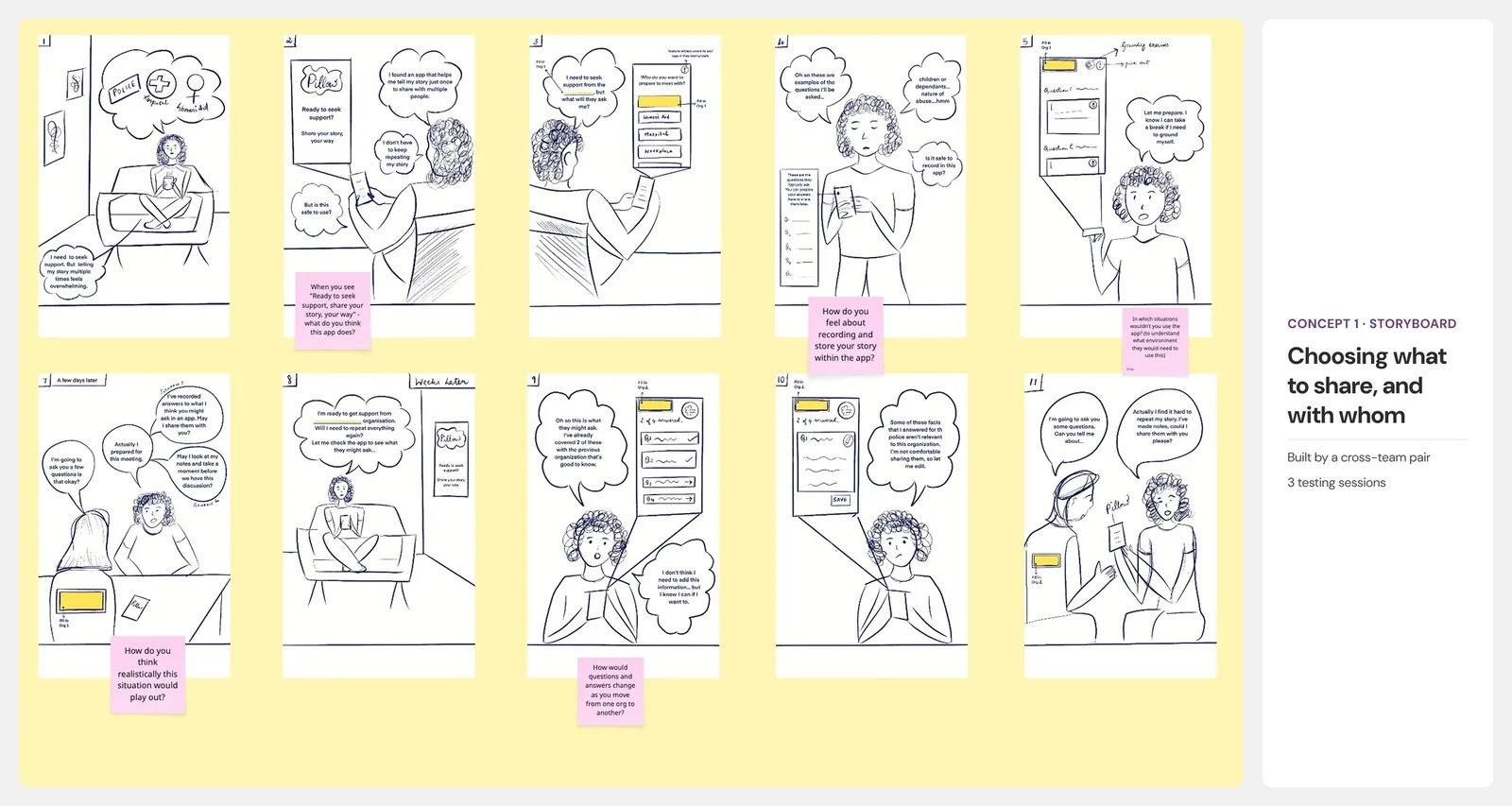
Concepts and iterationsMy part in the testing
Scoped the test with the other leader, so the team's limited time went into testing one thing well.
Reviewed the prototype: My feedback led us to rethink how we asked about emotions, and to align headlines and supporting text in one consistent voice.
Reviewed the storyboard: My feedback highlighted that SafeLives research shows police interviews are conversational, not form-based, so I flagged that showing "questions usually asked by police" could set unrealistic expectations. This led to a change: we now show example questions, with the organisations left blank so each participant can fill them in from their own experience. I took notes during one session Saranya facilitated.
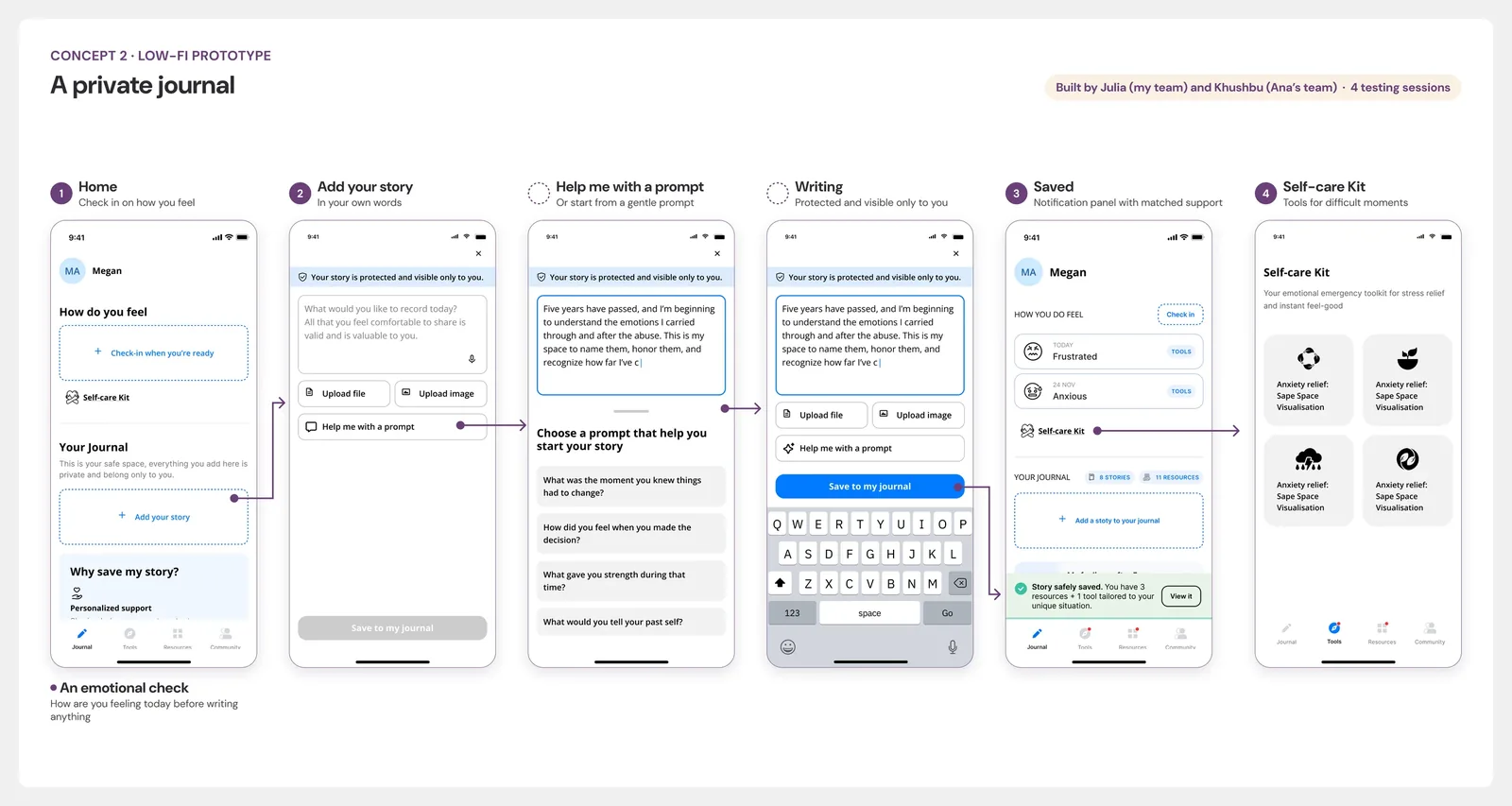
What the testing showed
1. The value was in deciding, not in telling once.
Participants responded to choosing what to record, how much to share with which organisation, and whether to share at all. Before writing anything, they needed to know why it was worth it and how their data was kept safe.
A tester participant said:
For other people, 'story' can be interpreted as something they made up.
The word "story" can minimise. That sent us towards words like record or notes, with sharing introduced later, once trust exists.
2. It depends on institutions we hadn't spoken to. If services insist on hearing it first-hand, documentation spares no one. Several participants suggested talking to organisations like Advance and Women's Trust. We hadn't tested that side of the system, and it became the clearest next step.
3. Pace, not endurance. A participant asked for language that gives permission to stop and come back.
We learned that Pillow should be treated as one tool within recovery, not the whole answer.
Outcome
What we ended with
The fellowship ended with two concepts tested with the community, and a framework for deciding between competing ideas. Lesley observed every testing session, then asked Ana and me to keep going. We said yes, and several of the ICs did too.
What happened next
After the fellowship: harms mapping workshop and a prototype iteration three to pitch
Milestone 2: volunteering, February to October 2026. In March 2026, IC Christina and I organised a harms-mapping workshop. I also did a competitor review. Products either supported emotional recovery or pointed to resources, and few connected the two.
What it led to: Iteration three of the prototype as a web app where survivors find community-vetted resources by describing their situation or by searching. Each change answers a top-rated harm: a data-safety notice comes first, fewer and tagged resources ease overwhelm, and the Quick Exit now sits on every screen.
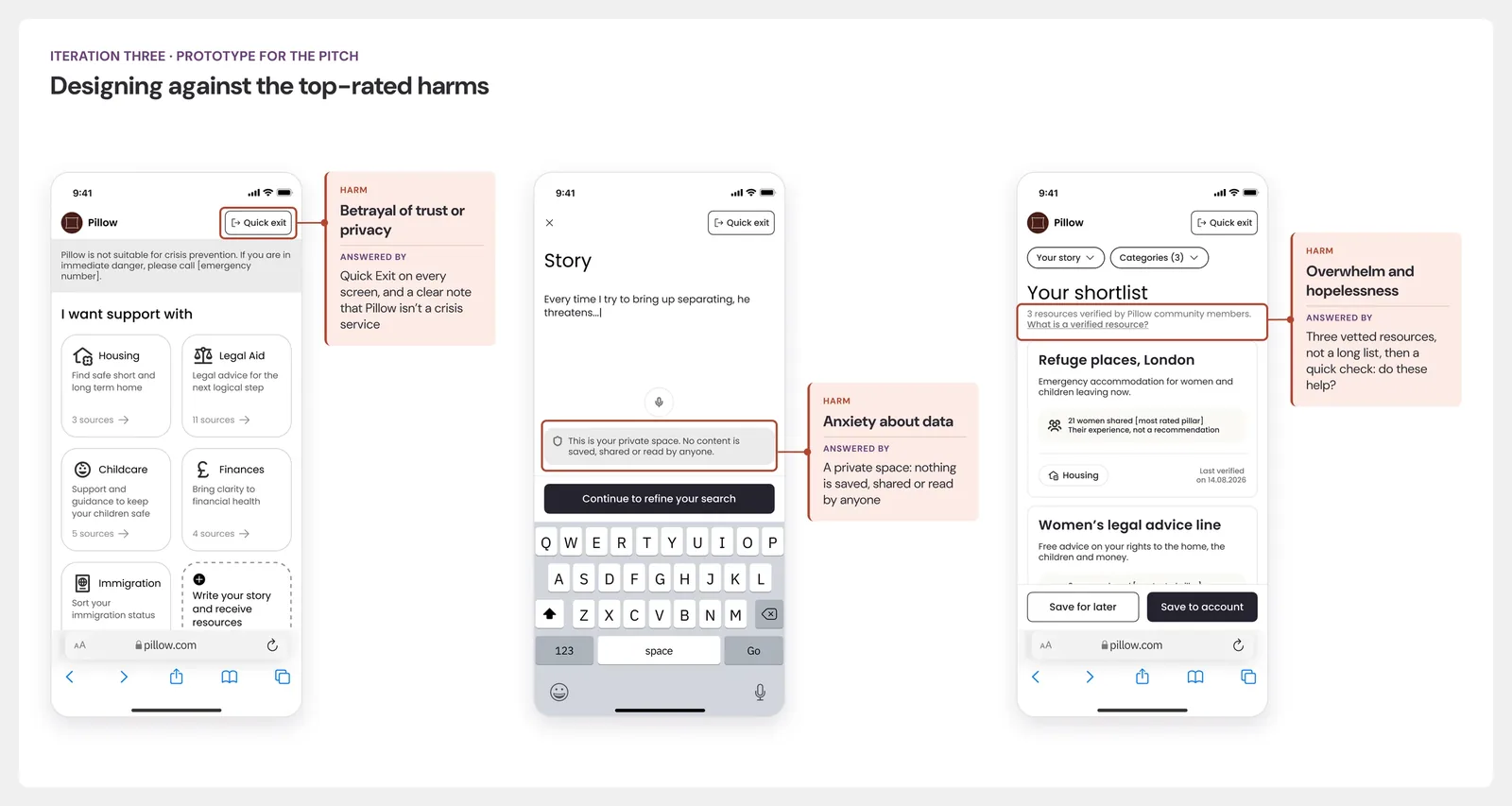
Getting it ready for the pitch
I set up a SWOT and asked Lesley to fill it in, so the strategy stayed in her words. A "What would help right now?" step fits support to the stage someone is at.
In October, I took a more hands-on role. I reviewed the prototype against the prioritised harms, and at a catch-up with Julia and Khushbu on 3 October, I led the prioritisation of what to change, sorted into critical needs, strategic wins and quick wins. My review asked for more hope and small wins, a clearer and more accessible close button, an easier way back to your story, and saving without an account, with logged out by default. Delivering this prototype closes milestone 2 of my volunteering with Pillow.
In their words
I’ve had the privilege of knowing Rocio for over 10 years, and witnessing her growth as a designer and now as a leader has been genuinely inspiring. During the UX for Change Responsible Design for Change Fellowship, Rocio stepped into the role of Regenerative Leader and quickly distinguished herself as an exceptional emerging leader. She brought together strong individual contributor skills with a deep commitment to developing regenerative leadership practices. Leading a team of three, she did so with compassion, structure, and clarity, creating an environment where people felt supported, accountable, and empowered to do their best work. What truly sets Rocio apart is her ability to balance craft and care. She brings strong direction and rigour to design while demonstrating an impressive sensitivity to context, people, and situations. Her approach to situational leadership is thoughtful and grounded, allowing her to adapt while staying aligned with shared values and goals. Rocio’s involvement with UX for Change has continued beyond the Fellowship through her passion for art therapy and her current role as a UX for Change Leader and member of the New Horizons group. In just a few months, she has shown tremendous potential to become an exceptional leader—one who leads with reflection, collaboration, and responsibility at the core. I feel incredibly lucky to have met Rocio and to have shared this journey with her. I am confident she will thrive in environments that value thoughtful leadership, meaningful collaboration, and long-term impact.
She really took the time to understand what we were trying to build and the women we were building it for. She brought thought, care and creativity to the process, and was brilliant to bounce ideas around with Rocio.
I found her leadership style pragmatic and kind. Whenever we had ambitious ideas, Rocio would direct us to think about scope and timelines to reasonably achieve our outcomes. She also encouraged us to look after our health and personal lives when work was hectic. I especially loved the grounding exercises she led at the start of every meeting. It was a pleasure to work under Rocio's leadership!
Reflection
What I'd do differently
The fellowship was my first time leading a team of three, and it continued after December: since January 2026, I've been part of UX for Change's Leadership Team Collective.
- I'd write a hypothetical brief early. I saw the gap and didn't act, worried that scoping would close down what we could explore. I'd still write one now, but one that names what's unknown and what we're leaving open: scope as a shared map that evolves and is agreed with the stakeholder early.
- I’d read the moment before choosing a method or a way to lead. Moving straight from five weeks of theory into practice, under pressure, we sometimes fell back on familiar methods like How Might We statements without noticing. A short summary of the methods would have helped the team choose. Leading was the same: Situational Leadership showed me that collaborative planning was the right instinct at the wrong moment, and the team first needed direction.
- I’d build the habit, not just the structure. I set up a shared research repository in Google Drive so both teams could see what research existed and who was doing what. But the work stayed in Miro, where it already lived, and nobody owned the repository. After the fellowship, it earned its place as our documentation home. The structure wasn’t entirely wrong, but the timing was.
Case studies